


Competitive gaming has developed far beyond informal matches between friends. Today, esports can involve organized competitions, individual players, teams, tournament organizers, spectators, broadcasters, rankings, and online communities. The Olympic Studies Centre describes esports as organized video-game competition, while research into the field identifies players, teams, leagues, tournaments, rules, and broadcasting as important parts of the wider ecosystem.
Games etruesports is a useful topic for understanding how games can move from ordinary entertainment into structured competition. Current material published by eTrueSports describes organized events for PC, console, and mobile titles, with different tournament formats and systems for registration, seeding, match rules, and player development.
This guide looks at the subject from several angles, including game genres, competitions, players, tournaments, teams, communities, technology, and the practical steps involved in entering competitive gaming.
What Is Games etruesports?
Games etruesports can be understood in the context of competitive video gaming and the organized esports environment surrounding games. The current eTrueSports Games guide presents its subject as a competitive environment involving tournaments and leagues across PC, console, and mobile titles. It also describes participation by different levels of players and tournament organizers.
It is useful, however, to distinguish between eTrueSports as a website or published information source and esports as the broader competitive-gaming industry. A website can report on games, tournaments, players, and esports without necessarily being the developer, publisher, or owner of every game it discusses. Current eTrueSports material includes both gaming and esports-related editorial content.
Games etruesports and Competitive Gaming
Games etruesports connects naturally with the wider idea of competitive gaming because esports is built around players competing under defined rules. Olympic research describes esports as organized video-game competition and notes that competitions can range from informal events to large-scale tournaments.
The competitive side of gaming adds structure to the experience. Instead of simply starting a match whenever players want, organized competition can involve registration, scheduled matches, rankings, brackets, referees, spectators, and published results. The exact systems vary by game and tournament organizer.
How Gaming Becomes an Esports Competition
A video game becomes part of esports when players compete in an organized and measurable environment. That environment normally requires a defined game, rules, opponents, a method for determining results, and some form of organized competition.
The level of organization can differ considerably. A small online community tournament may have a simple bracket, while a professional league can involve stages, qualification systems, teams, broadcasters, sponsors, and formal competition rules. Research on esports describes these organized structures as one of the characteristics that separates esports from ordinary gaming.
Who Can Participate in Games etruesports?
Games etruesports can be approached by people with different levels of gaming experience. The current eTrueSports Games guide says its competitive environment is intended for casual players, semi-professional players, and tournament organizers.
That does not mean every event accepts every player. Individual competitions can set their own requirements, including age limits, skill levels, regions, game versions, team sizes, or registration rules. Players should therefore read the rules of a specific event before entering.
Types of Games in Games etruesports
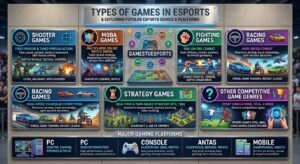
Competitive gaming is not limited to one style of game. Research into esports identifies several established categories, including multiplayer online battle arenas, first-person shooters, real-time strategy games, collectible card games, and sports games.
Shooter Games
Shooter games are built around combat, accuracy, positioning, reaction time, and tactical decision-making. Competitive shooters may use individual, duo, or team-based formats depending on the title.
Team shooters also place strong emphasis on communication. Players often need to share information about opponents, positions, resources, and tactical choices while making decisions quickly.
MOBA Games
MOBA, or multiplayer online battle arena, games generally place teams against each other in structured multiplayer matches. Players usually control individual characters with different abilities and roles.
The competitive nature of MOBAs comes from the combination of mechanical skill, strategy, teamwork, resource management, and decision-making. MOBAs are recognized as one of the established Games etruesports categories in academic research.
Fighting Games
Fighting games generally focus on direct competition between individual characters or small groups of characters. Players need to understand attacks, defensive options, timing, movement, combinations, and matchup-specific strategies.
Because matches can depend heavily on individual decisions, fighting games provide a clear example of how esports can include both individual skill and strategic preparation.
Racing Games
Racing games bring competitive gaming into driving and motorsport-style experiences. Players may compete for the fastest time or race directly against opponents.
Competitive racing can involve detailed knowledge of tracks, vehicle behavior, braking points, acceleration, and consistency. The exact rules and equipment depend on the game and competition.
Strategy Games
Strategy games reward planning, resource management, tactical decisions, and the ability to react to an opponent. Some are played in real time, while others use different forms of turn-based or structured decision-making.
Real-time strategy games are among the game categories historically associated with Games etruesports research.
Other Competitive Game Genres
Esports also extends into other categories. Sports simulations, card games, battle royale games, and other multiplayer titles can all create competitive environments when organized matches and rules are established.
The important point is that esports is not defined simply by one particular genre. Different games create different competitive systems, and the rules have to match the mechanics of each title.
PC, Console, and Mobile Games
Modern competitive gaming is not restricted to computers. The current eTrueSports Games guide describes competitions involving PC, console, and mobile titles.
Each platform can create different competitive considerations. Players may use different control systems, performance settings, network connections, and display hardware. Tournament organizers therefore need clear technical rules so participants understand the conditions under which matches will be played.
How Games etruesports Competitions Work
Competitive events need more structure than ordinary multiplayer sessions. The current eTrueSports Games guide describes event registration, published rules, schedules, player ratings, seeding, and referee oversight as parts of its described competition system.
Individual and Team-Based Competition
Some esports competitions are built around individual players, while others require teams. The format depends on the game.
Individual competition places more responsibility on one player’s decision-making and execution. Team competition adds communication, role distribution, strategy, and coordination to the challenge.
Match Rules and Game Settings
Rules establish how a competition should be played. They can cover the game version, match format, allowed settings, player eligibility, scheduling, disconnects, disputes, and other situations.
Clear rules are important because competitors need to know what is permitted before the match begins. Event organizers can publish additional requirements according to the game and tournament.
Player Ratings and Seeding
Ratings can be used to represent competitive performance or skill. Research into Games etruesports notes that ranking systems can be used to differentiate players by competitive performance.
Seeding is related but serves a tournament-management purpose. Organizers can use rankings or other qualifying information to determine how players or teams are placed within a bracket or opening stage. The exact method differs between competitions.
Match Results and Rankings
Results provide the basic record of competitive performance. Depending on the competition, wins, losses, points, game scores, or other statistics may affect a player’s or team’s position.
A ranking system should always be interpreted according to the rules of the particular competition. Different games and organizers use different methods for measuring progress.
Fair Play and Competitive Rules
Fair competition depends on participants following the published rules. In organized esports, fair play can involve restrictions on prohibited software, cheating, match manipulation, unsporting behavior, or other violations.
The eTrueSports Games guide describes referee oversight and rules as mechanisms intended to support competitive integrity.
Who Are Games etruesports Players?
Casual Players
Casual players participate mainly for enjoyment rather than professional competition. They may play occasionally, join community events, or enter smaller competitions without treating esports as a full-time pursuit.
Casual participation can also be a starting point for people who later decide that they want to compete more seriously.
Competitive Players
Competitive players approach games with greater emphasis on improvement and results. They may practice specific skills, study opponents, review previous matches, and participate in ranked or organized competitions.
The difference between casual and competitive play is therefore often about the level of commitment and structure rather than simply the game being played.
Professional and Semi-Professional Players
Professional players compete at a level where esports may form an important part of their working life. Semi-professional players compete seriously but may have other careers, studies, or commitments.
The path is not identical for everyone. Some players progress through amateur events and regional competitions, while others enter organized teams or leagues through different routes.
Player Skills and Game Knowledge
Successful competitive players need more than fast reactions. Depending on the game, useful abilities can include mechanical control, strategic thinking, communication, map or track knowledge, decision-making, and understanding of game mechanics.
Research into Games etruesports identifies hand-eye coordination, tactical decision-making, and the ability to outsmart opponents among factors relevant to differences in player skill.
Practice, Training, and Replay Analysis
Practice gives players an opportunity to improve weaknesses and develop consistency. Reviewing previous matches can also reveal repeated mistakes and useful patterns.
The current eTrueSports Games guide recommends practice, replay review, training with teammates, and practice leagues as ways players can work on improvement.
Communication and Teamwork
Team games require players to exchange information and make coordinated decisions. Good communication can help teammates understand objectives, respond to opponents, and execute strategies.
Teamwork is therefore not simply about having several skilled players. A team also needs a system for turning individual abilities into coordinated performance.
Games etruesports Tournaments
What Is an Esports Tournament?
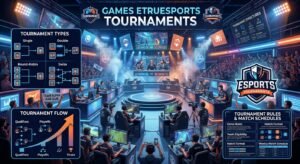
A tournament is an organized competition in which players or teams progress through a defined structure toward a final result. It can be small and community-based or part of a large professional esports circuit. Tournament formats determine how participants are matched and how winners advance.
Single-Elimination Tournaments
In a single-elimination tournament, a participant is eliminated after losing the relevant match or series. The bracket continues until one participant remains. This structure can make events relatively straightforward to follow, but a single loss can end a participant’s run.
Double-Elimination Tournaments
Double elimination gives participants a second route after a first loss. Competitors generally move into a lower bracket rather than immediately leaving the tournament.
The exact structure varies, but the format is widely used in esports. Current examples include major competitions using double-elimination playoff brackets.
Round-Robin Tournaments
In a round-robin format, participants play against multiple or all other participants within the relevant group or stage, depending on the event rules.
This can provide more matches than a simple elimination bracket. Current Games etruesports competitions use round-robin stages in different ways, including regular-season formats.
Swiss Tournaments
A Swiss system pairs competitors with others who have similar records while generally avoiding repeat matchups during the stage where possible.
Swiss formats are now used in major esports competitions. For example, current League of Legends and other esports events have incorporated Swiss stages before knockout rounds.
Qualifiers, Playoffs, and Finals
Large competitions often divide participation into stages. Qualifiers can determine which players or teams reach a main event. Playoffs then reduce the field until the final stage.
The precise pathway depends on the tournament. Current professional esports examples demonstrate combinations of qualification stages, Swiss stages, and elimination playoffs.
Tournament Rules and Match Schedules
Tournament rules tell participants what they need to know before competing. Schedules establish when matches take place, while event systems can communicate brackets, results, and progression.
The eTrueSports Games guide says its described events include rules, schedules, and registration information.
Games etruesports Teams
How Esports Teams Work
A team brings multiple players together under a shared competitive identity. Team structures vary according to the game, because some games require larger rosters while others focus on smaller groups.
A team’s success depends on more than individual ability. Coordination, preparation, strategy, and communication can all influence competitive performance.
Player Roles and Responsibilities
Players may have different responsibilities depending on the game. One player might focus on attacking, another on support, while another handles a particular strategic role.
The exact roles are game-specific, so readers should avoid assuming that one team’s structure applies to every Games etruesports title.
Team Communication
Communication helps players share information and coordinate decisions during a match. Teams can use voice communication, predefined signals, strategic calls, and other methods. The goal is to make several individual players operate as a coordinated unit.
Team Strategy and Coordination
A team strategy establishes how players intend to approach objectives, opponents, resources, and different stages of a match.
Strong coordination also allows a team to adapt when the original plan stops working. Competitive games are rarely completely predictable, so flexibility matters.
Coaches and Support Staff
Professional esports organizations can involve people beyond the active players. Depending on the organization, coaches and support staff may assist with preparation, strategy, analysis, scheduling, or player development.
Not every amateur team has this level of support, so the structure can range from a small group of players to a larger professional organization.
Preparing for Competitive Matches
Preparation can include reviewing previous games, studying opponents, practicing specific situations, checking equipment, and discussing strategy.
The eTrueSports Games guide also identifies replay review, teammate training, and coaching or practice opportunities as parts of player improvement.
Games etruesports Communities
Players and Gaming Communities
Gaming communities bring people together around shared games and interests. They can exist on dedicated platforms, social networks, forums, streaming services, and private communication channels. Communities can help players exchange advice, find opponents, organize events, or simply discuss games.
Fans and Spectators
Not everyone involved in esports competes. Spectators watch matches, follow players and teams, discuss results, and participate in fan communities.
Broadcasting is an established part of the esports ecosystem, and research describes esports competitions as involving systems of competition and broadcasting.
Streaming and Live Matches
Streaming allows audiences to watch competitive matches while they happen or view recorded gameplay later. It has become an important way for Games etruesports events to reach audiences beyond physical venues. The exact streaming service depends on the game, tournament organizer, region, and event.
Social Interaction and Gaming Discussions
Online communities provide space for conversations about strategies, updates, results, players, and tournaments. These discussions can help newcomers learn from more experienced players.
However, community posts are not automatically authoritative. Important information such as tournament rules, eligibility requirements, or event schedules should be checked against official event sources.
Finding Teammates and Practice Partners
Communities can make it easier for players to find people with similar interests and skill levels. Players can use gaming groups, social platforms, community servers, or organized events to meet potential teammates.
Finding a good teammate involves more than matching skill. Availability, communication style, reliability, and shared goals can also matter.
Community Events and Competitions
Small community competitions can give players experience before they enter larger events. They may also create opportunities for spectators and organizers to interact.
The current eTrueSports material describes community participation alongside organized competitive events and player development.
How to Get Started With Games etruesports
Choose a Competitive Game
Start with a game that genuinely interests you. Enjoyment matters because competitive improvement usually requires repeated practice.
Consider the genre, platform, player population, available competitions, and whether the game supports the style of competition you prefer.
Learn the Rules and Game Mechanics
Before entering a competition, understand the basic mechanics and rules of the game. Learning the controls is only the beginning; competitive players also need to understand objectives, maps, characters, equipment, strategies, or other systems relevant to the title.
Create and Prepare Your Gaming Setup
A suitable setup should allow you to play reliably. Depending on the game and platform, this may involve a compatible device, stable internet connection, suitable controls, and a comfortable environment.
Hardware requirements vary by title, so players should check the game’s own requirements rather than relying on a generic esports setup.
Practice and Improve Your Skills
Consistent practice is more useful than simply playing large numbers of matches without reflection. Focus on specific weaknesses and track whether they improve.
Replay analysis can be particularly useful because it lets players examine decisions after the pressure of a live match has passed. The Games etruesports guide specifically recommends practice and replay review as improvement methods.
Join a Gaming Community
A good community can help you find advice, practice partners, teammates, and competition opportunities. Look for communities connected to the specific game you play rather than assuming that one general esports group will provide everything you need.
Find a Team or Practice Partners
Team games require people who can practice together and communicate effectively. Start with players who have compatible schedules and similar goals.
If you are not ready for a formal team, regular practice partners can still help you develop competitive habits.
Enter Suitable Competitions
Begin with competitions that match your experience and skill level. Read the rules, registration requirements, schedule, and format before signing up.
The current eTrueSports Games guide describes a process involving account creation, game identification, event filters, and event registration.
What Makes Games etruesports Different From Casual Gaming?
Organized Competition
Casual gaming is usually driven by personal enjoyment, while esports introduces organized competition with defined opponents, rules, and results.
The distinction is not that casual players lack skill. Rather, esports adds a formal competitive structure around the game.
Structured Rules and Formats
Competitive events need consistent rules so participants know what is allowed and how results are determined.
Tournament formats such as single elimination, double elimination, round robin, and Swiss provide different ways to organize those matches.
Rankings and Competitive Progress
Rankings can give players a way to measure competitive performance. Some systems use ratings or points, while others rely on tournament results.
Research into Games etruesports identifies ranking systems as an important way of distinguishing competitive performance between players.
Teams and Collaboration
Team-based esports adds another layer that casual gaming may not require. Players have to coordinate actions, communicate information, and follow shared strategies.
Tournaments and Events
Tournaments give competitive players a structured environment in which their results can be compared with those of other participants.
Events can range from small online competitions to major professional tournaments with multiple stages and large audiences.
Spectators and Esports Communities
Esports also creates an audience around competitive play. Fans can follow matches, watch streams, discuss teams, and participate in communities even when they are not competing themselves.
Read Also: The Complete Guides ThePortableGamer for Modern Gamers
Benefits and Challenges of Games etruesports
Skill Development
Competitive gaming can encourage players to develop game-specific skills, decision-making, strategic thinking, and coordination. Research has identified tactical decision-making and hand-eye coordination among factors associated with esports performance.
Teamwork and Communication
Team competitions require players to communicate and coordinate. These demands make teamwork an important part of many esports games.
Competition and Community Participation
Organized competition can give players opportunities to meet others who share their interests. Games etruesports communities can also provide a place to exchange knowledge and participate in events.
Time Management
Competitive improvement requires practice, but unlimited play is not a sustainable strategy for everyone. Players need to balance gaming with education, work, family, sleep, exercise, and other responsibilities.
Maintaining Healthy Gaming Habits
Healthy gaming involves taking reasonable breaks, maintaining good sleep habits, staying physically active, and avoiding excessive play.
Competitive goals should not require someone to ignore their broader wellbeing. A sustainable routine can make it easier to continue playing over the long term.
Challenges of Competitive Play
Competitive gaming can involve pressure, losses, disagreements, technical problems, demanding schedules, and the need to maintain consistent performance.
Players can reduce some of these difficulties by setting realistic goals, learning from losses, communicating respectfully, and maintaining boundaries around gaming time.
The Role of Technology in Games etruesports
Online Gaming Infrastructure
Competitive online games depend on technical systems that allow players to connect and exchange game data. Network quality can affect the experience, particularly in games where quick reactions matter.
Match and Tournament Systems
Digital tournament systems can manage registrations, brackets, schedules, match information, and results.
The current Games etruesports guide describes event filtering, registration, match structures, and related tournament systems as part of its described competitive experience.
Streaming Technology
Streaming technology allows matches to reach audiences outside the players’ immediate location. It has helped connect competitions with spectators and online communities.
Match Statistics and Replay Analysis
Statistics and replays give players additional information about performance. A replay can show decisions that were difficult to notice while playing in real time.
The eTrueSports Games guide specifically mentions replay review and stat-tracking tools as methods that can support player improvement.
Mobile and Cross-Platform Gaming
Mobile devices have expanded the range of hardware on which competitive games can be played. The current eTrueSports Games guide describes PC, console, and mobile titles within its competitive-gaming coverage.
Cross-platform competition, however, depends on the individual game. Players should always check whether a particular title supports cross-platform play and whether a tournament permits it.
The Future of Games etruesports

Growth of Competitive Gaming
Esports has developed into a broad ecosystem involving games, players, teams, tournament operators, leagues, media, and communities. Research from the Olympic Studies Centre describes esports as a structured competitive field with organized events and athletes.
Expansion of Mobile Esports
Mobile gaming provides another route into competitive gaming. As more games are designed for mobile devices, organizers can create competitions around titles specifically built for that environment.
The important point is that mobile esports should be considered alongside, rather than automatically treated as identical to, PC and console competition.
Streaming and Digital Communities
Digital communities are likely to remain important because they connect players, spectators, creators, and organizers.
Streaming also allows competitive gaming to be followed remotely, making the audience less dependent on physical event locations.
New Competitive Game Experiences
New games can introduce different mechanics, formats, and competitive systems. As developers experiment with multiplayer experiences, the esports landscape can also change. This means there is no permanent list of games that defines competitive gaming forever.
Opportunities for Players, Teams, and Creators
The esports ecosystem can involve more roles than simply playing matches. Depending on the scene, people may participate as players, coaches, analysts, broadcasters, content creators, organizers, referees, or community managers. The exact opportunities vary by game, region, organization, and level of competition.
Final Thoughts
Games etruesports provides a useful way to explore the relationship between video games and organized competition. The subject covers far more than simply playing a game: it can involve different genres, individual and team competition, tournament formats, player development, rankings, communities, streaming, and technology.
Once a player understands the game, rules, tournament format, and community around it, the competitive side becomes easier to navigate.
At the same time, specific claims about a particular platform, tournament, team, or event should always be checked against the relevant official source. Esports changes quickly, and formats, supported games, schedules, and participation requirements can change over time.
FAQs About Games etruesports
What Is Games etruesports?
Games etruesports covers video games and organized competitive gaming.
It includes PC, console, and mobile gaming competitions.
What Types of Games Are Included?
Esports includes shooters, MOBAs, fighting, racing, strategy, and sports games.
The exact games depend on each tournament or organizer.
What Platforms Are Used?
Competitive gaming is available on PCs, consoles, and mobile devices.
The platform depends on the game and competition.
How Do Games etruesports Tournaments Work?
Tournaments can use single elimination, double elimination, round robin, or Swiss formats. Each event sets its own rules, schedule, and match structure.
Who Can Participate?
Participation depends on the competition’s eligibility requirements.
Events may include casual, semi-professional, or professional players.
How Do Esports Teams Work?
Esports teams bring players together to compete toward a shared goal.
Communication, coordination, and strategy are important for team performance.
Why Are Communities Important?
Esports communities connect players, fans, creators, and organizers.
They support discussion, teamwork, learning, and participation in events.
How Can Beginners Start?
Beginners can choose a game, learn its rules, practice, and join its community.
They can then enter suitable competitions as their skills improve.

4 Comments
Pingback: Game Event Under Growthgameline: Features, Rewards, and Gaming Tips
Pingback: Gadget Eurogamersonline: Essential Gadgets for a Better Gaming Setup
Pingback: Gaming Tips PBLinuxTech: How to Play Smarter and Win More Games
Pingback: ETSGAMEVENT of the Year: Detailed Review and Important Updates